On 1 October the Netherlands Arbitration Institute held its day for in-house lawyers in Rotterdam. The theme was the new geopolitical reality. Arend Jan Boekestijn opened with where the world is heading. Rieme-Jan Tjittes gave a workshop on what your contract says when things go wrong, and Hilde van der Baan on the dispute that follows.
I gave the third workshop, three times in a row: how AI can help a lawyer see these risks earlier. Lawyers rarely bring the news into their contract work. Between the keynote and the contract there is a question nobody asks in a structured way: what is going on in the countries this contract touches?
So we built a tool for the day. It is called GEO, and it is online at geo.mino.law.
What it does
You upload the contract you are about to sign, and say whether you advise the buyer or the supplier. GEO finds which countries play a role and in what role: where the parties are established, where delivery takes place, which law applies, where the seat of arbitration is. It checks seven public sources about those countries, and turns what it finds into questions, each tied to a clause.
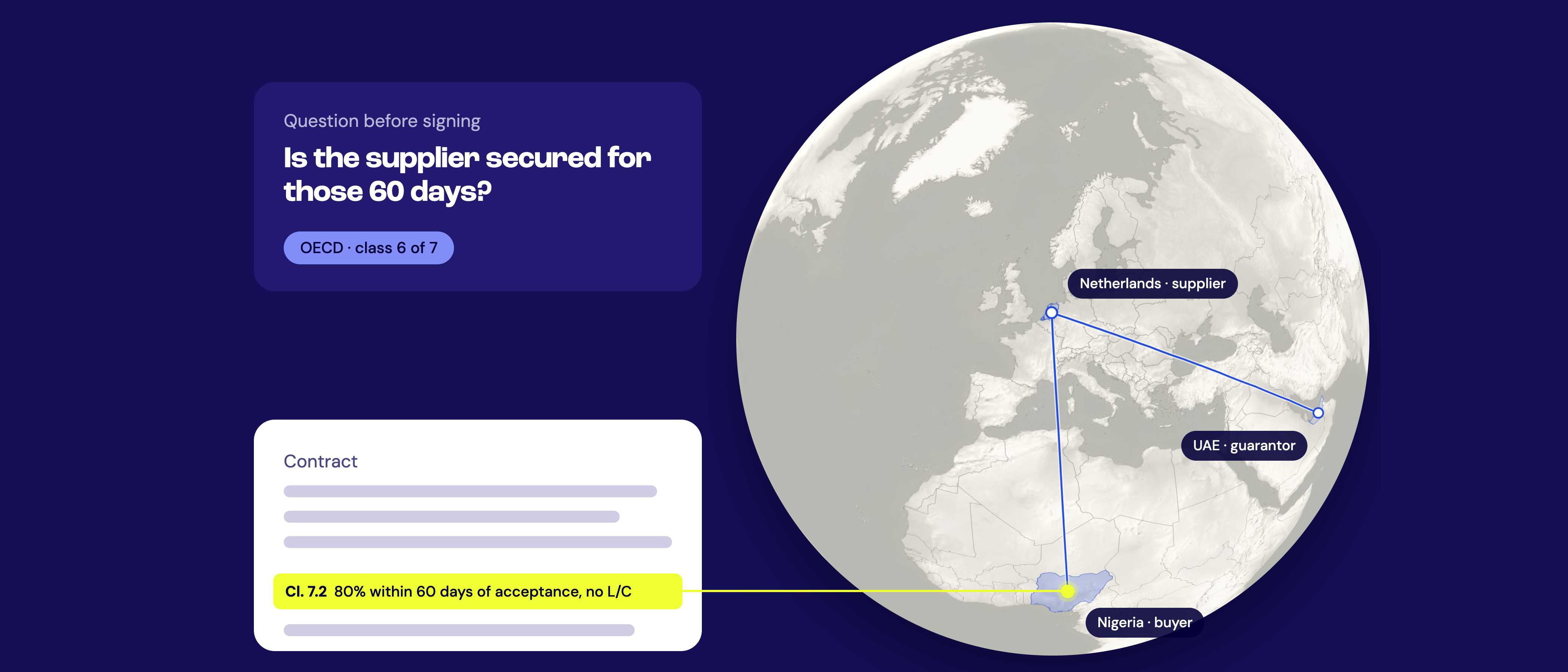
Take the sample contract. A Dutch supplier installs a production line at a mill in Nigeria. The buyer’s parent company in Dubai guarantees payment. Clause 7.2 says the buyer pays 80% within 60 days of acceptance, and no letter of credit is required. The OECD places Nigeria in class 6 on a scale of 0 to 7.
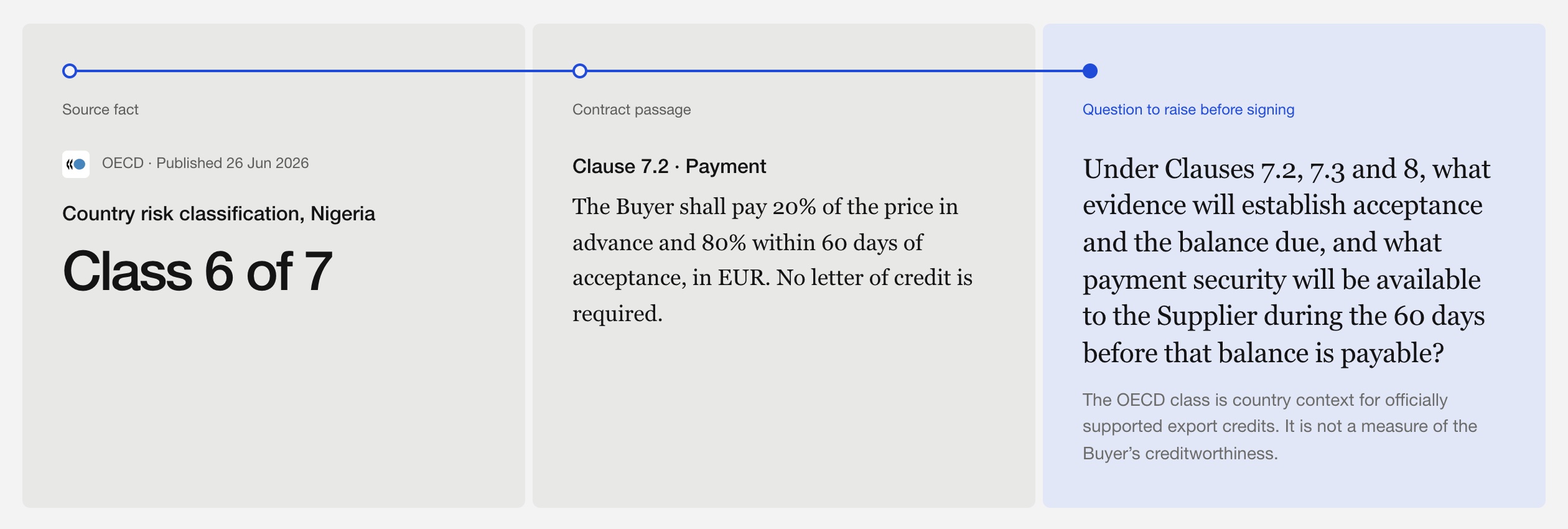
GEO does not say that this is a risk. It asks what payment security the supplier has during those 60 days. Behind the question are the passage from the contract and the source with its date. The answer stays with the lawyer.
Three layers
In the workshop I took the tool apart in three layers. I think they hold for most AI tools.
The model. The power from the wall. GEO uses a language model to read the contract and to connect clauses to sources. Which model is a setting. Many companies already have a contract with an AI supplier, and GEO runs on OpenAI, Azure OpenAI, Anthropic or Mistral.
The sources. Current information you can check. Every check fetches the sources again: the Dutch travel advice, the UN Treaty Collection, the OECD country risk classification, the World Bank, the EU Sanctions Map, GDACS and ReliefWeb. A second example from the sample: the contract names flood as force majeure, with notice within seven days. GDACS, the disaster alert system of the UN and the European Commission, reports floods in Nigeria. GEO puts the two side by side and asks when the seven days start. GDACS is a source, not a model guessing.
Your own knowledge. What matters in your work. This is the layer most people do not see, and it is where the legal work is.
The knowledge is in the rules
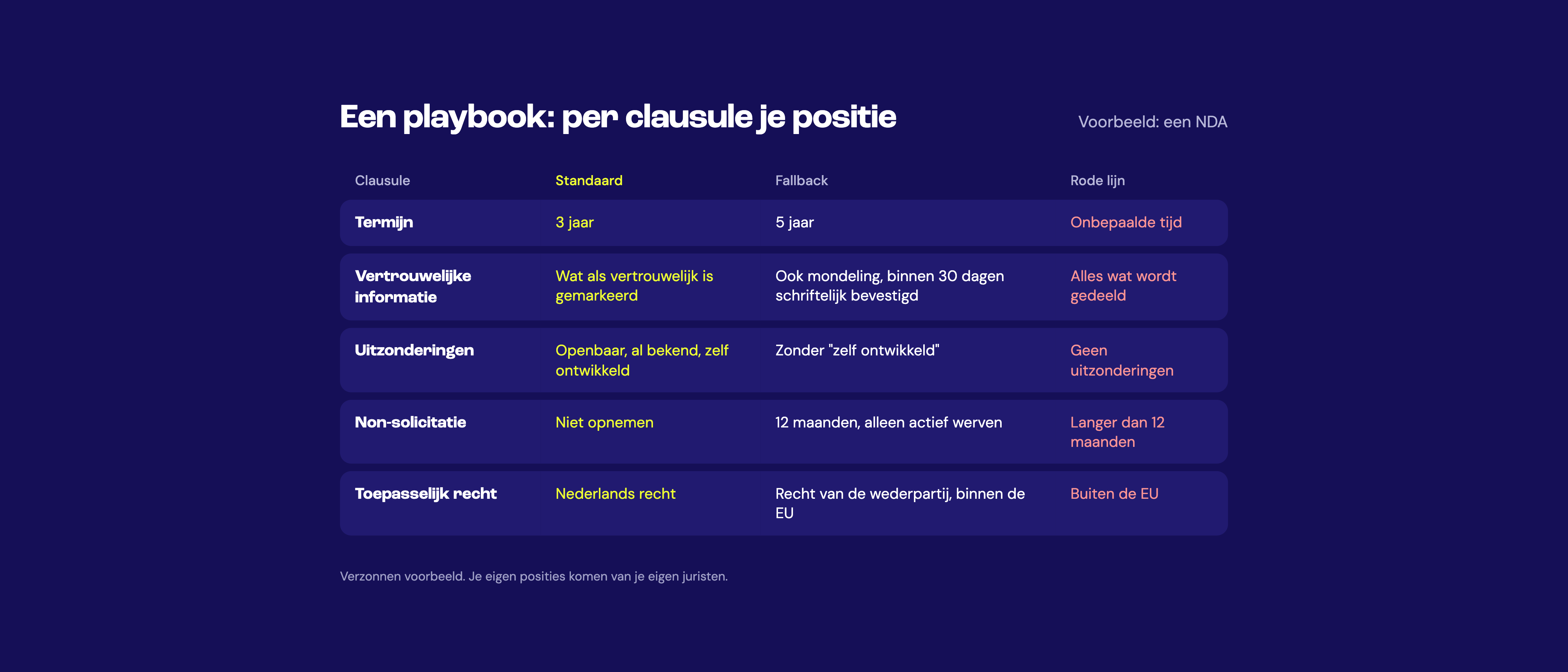
The model does not know on its own what a lawyer would find obvious. So GEO gives it rules, and every rule is a piece of legal knowledge written down. A few of them:
- An arbitration institution in Paris does not make Paris the seat.
- A price in US dollars does not make the United States a party.
- Being party to the New York Convention does not mean an award can be enforced.
- An OECD class is not a judgement on the other party. Do not call it high or low.
- A list of sanctions regimes is not a screening.
No IT department writes these rules. A lawyer does.
Tested like a candidate
We tested GEO the way you would test a new colleague: with contracts that contain traps. There are ten. One is in Dutch. One mentions Russia only in a ban on resale. One has an instruction to the AI hidden in a clause. Three are real contracts from public filings. Each comes with what a good reviewer should find, and what it should leave alone.
That is also a lawyer’s job. Someone has to decide when a tool like this can be trusted, and on what evidence.
Seven steps
Underneath, GEO is seven steps. Five are ordinary code and two use a model. Code fetches the sources and cuts the contract into numbered passages. The model reads. Code then checks that every fact points to a passage that exists, and holds it back with a warning if it does not. The model connects clauses to sources, and code checks again. That split is what I mean by legal engineering: cut the work into steps, and decide for each step whether it is code, a model or the lawyer.
GEO is a prototype. It is free and needs no account, but do not put a confidential contract in it. If you deal with Nigeria every week, you would build it around Nigeria. That is the point: tools like this are now small enough to build for one team’s work.
More about how it is built is on the workflow page.