In July 2025 a Dutch lawyer cited eight rulings in a tenancy case, each with an ECLI number. One number did not exist. The other seven belonged to entirely different cases, including a divorce and a criminal case. She had taken the references from an AI tool and not checked them.
On 27 July 2026 the disciplinary council in ‘s-Hertogenbosch reprimanded her (ECLI:NL:TADRSHE:2026:93). The complaint was not that she used AI. It was that she took over the output without reading the rulings. Her defence, that she saw the tool as a kind of search engine, did not help.
One sentence in that decision stays with me. As a mitigating circumstance, the council took into account that AI literacy was “not yet common” in July 2025. It does not say that this still holds for later.
What the AI Act asks
AI literacy is in Article 4 of the AI Act. It has applied since 2 February 2025 to everyone who provides or uses AI systems, so also to a firm or department that uses Copilot or ChatGPT.
In July 2026 the article was amended by the Digital Omnibus (Regulation (EU) 2026/1744). It used to say that you take measures to ensure, to the best of your ability, a sufficient level of AI literacy. Now it says that you take measures to support its development, among your staff and others who work with AI on your behalf. It adds explicitly that you do not have to guarantee any specific level for any individual.
So it is an obligation of effort, not of result. But the article has not gone away, and it looks at the context in which you use AI. For a legal team, that context is legal work.
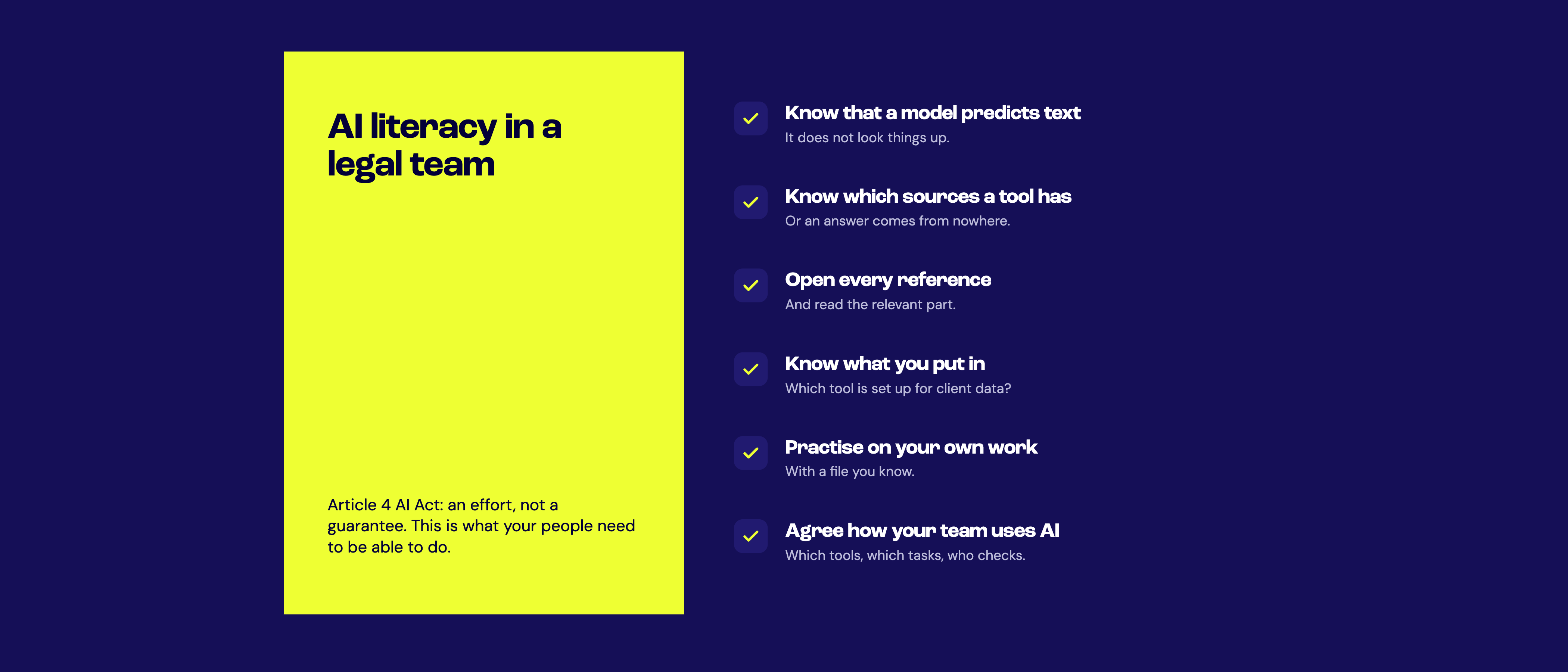
The AI Act does not say what AI literacy means in a legal team. This is what I see in training sessions that people need to be able to do.
1. Know that a language model predicts text
A language model does not look things up. It writes the text most likely to come next. Usually that text is right, which is why it does not stand out when it is wrong. An ECLI number that looks right is, to a model, just text.
This is the basis. Anyone who understands it reads an output differently.
2. Know which sources a tool has
A general chatbot has no access to case law unless the tool brings those sources in and shows them. A Dutch legal assistant does work with legislation and case law. Copilot can reach your own documents.
If you know which sources a tool has, you also know when an answer comes from nowhere.
3. Open every reference
If an output cites a ruling, an article or a source, open it and read the relevant part. That is what the council found missing in the case above. A tool that does not show its source costs more time to check than it saves.
4. Know what you put in
Which tool, which account, where the data is processed, what is stored and whether it is used for training. A team member does not have to set this up, but does need to know which tool is set up for client data and which is not.
5. Practise on your own work
A general explanation of AI does not stick. What stays is the moment someone sees what a tool does with a file they know: where it is right, and where it goes wrong. That is why I train on a team’s own work, with their own documents and questions.
6. Agree how your team uses AI
Which tools, for which tasks, and who checks the output. Short, on one page, and updated when something changes. Then a new colleague knows where they stand, and the team knows what it has already done to help people along.
What it is not
AI literacy is not a course in machine learning. Nobody in a legal team needs to know how a model is trained. It is about knowing what a tool does, what it does not do, and what the lawyer has to keep doing.
One caveat: this is not advice on what Article 4 asks of your organisation in particular. That depends on which systems you use and how. What I do know is that the six points above make the difference between a team that uses AI and a team that understands the output. That is what our trainings are for.