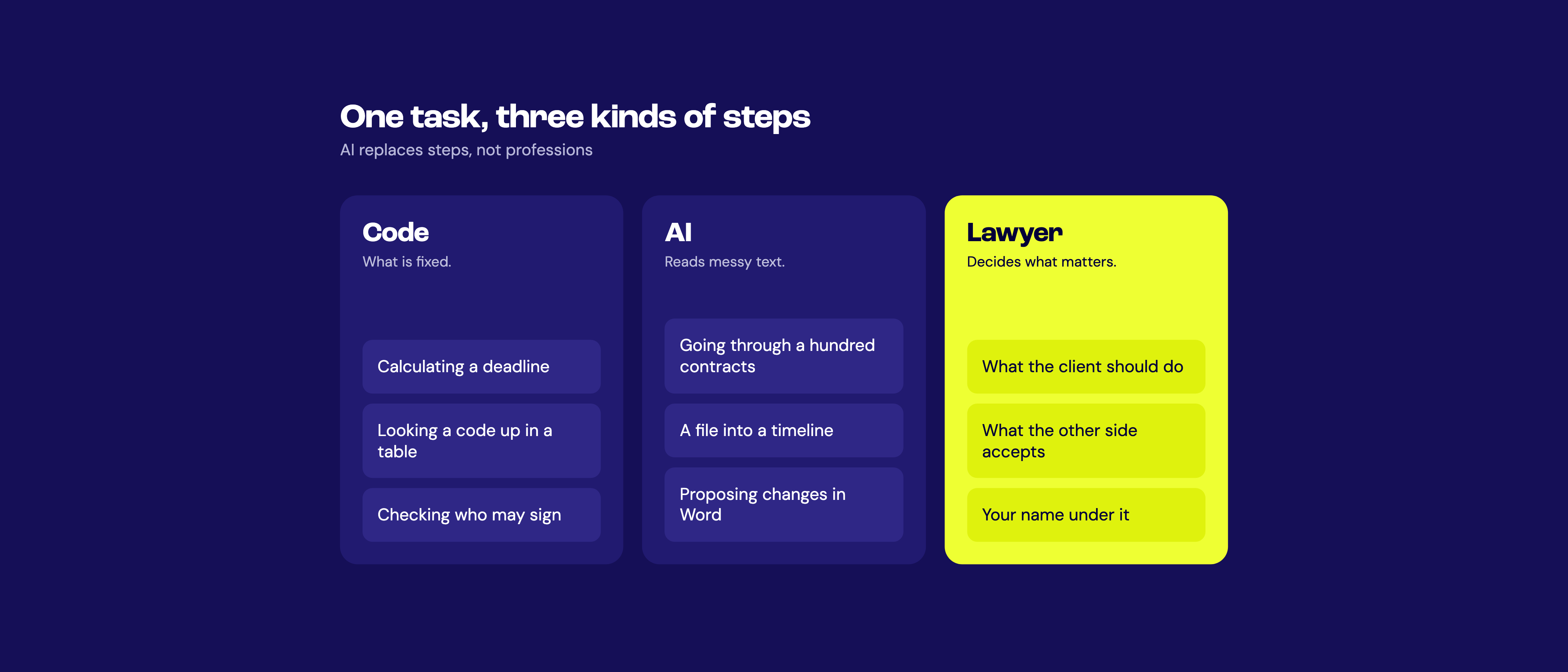
In October I stood in front of a room of in-house lawyers and general counsels. One of the first slides said what I think happens to their work: AI takes over the executing, and the lawyer becomes the organiser. “You already organise: firms, budget, a team. Soon you will organise machines too. And you sign for it.”
That is my answer to whether AI will replace lawyers. The question is too big. A profession is not replaced. A step is. If you want to know what happens to your work, you first have to cut the work into steps.
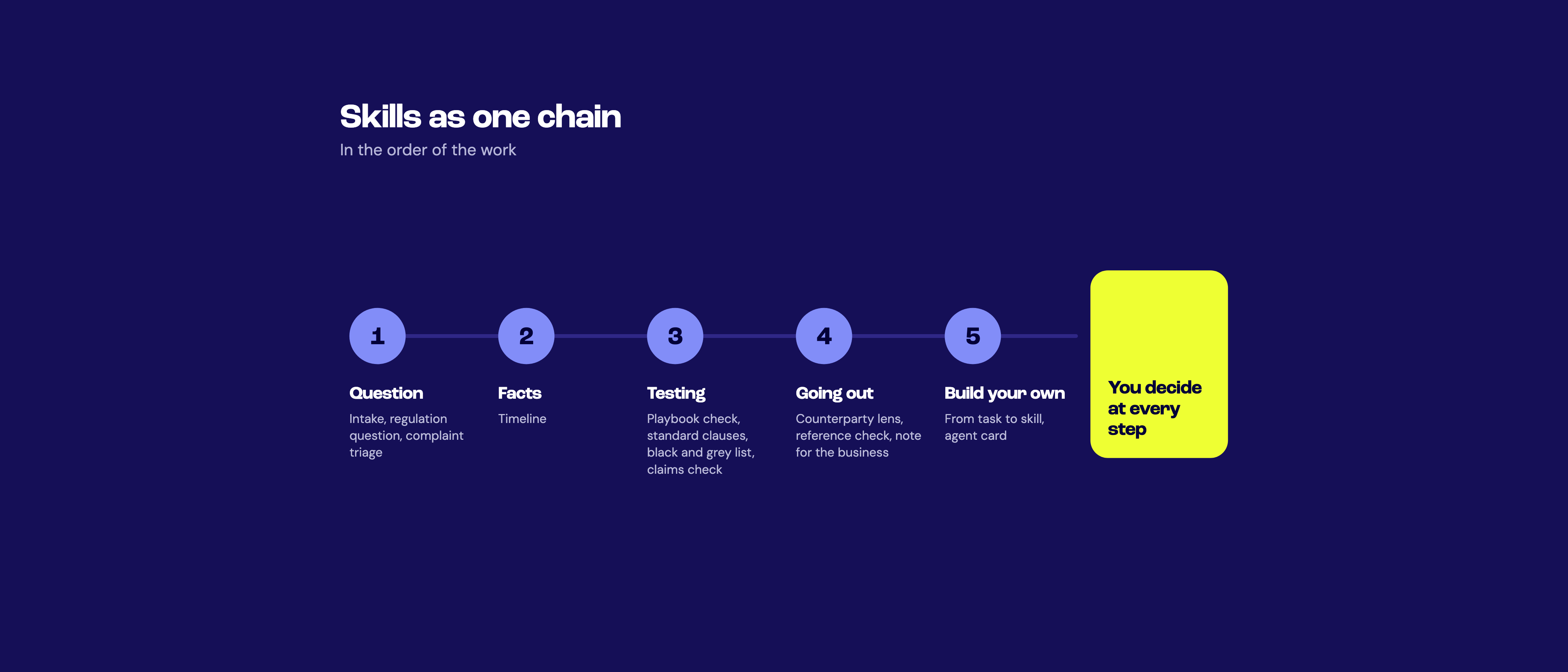
That is also what I do when I build something. Take one task that keeps coming back, write down the steps, and decide per step who does it: code, AI or a lawyer.
1. Steps for code
A deadline is a calculation. Who may sign depends on region, type of contract and amount. Whether a goods code falls under sanctions is in official tables.
Code calculates and compares: a date, an amount, a list. Same input, same result. My rule is: what code can do, you do with code. Steps like these need no language model, and could have been automated without AI. In the sanctions check we built for a law firm, the system looks the code up in the official tables. The signing authority of a legal department became a clickable PDF.
These steps leave your day. Few lawyers miss them.
One thing stays yours: the rule itself. Code calculates reliably, also with the wrong time limit. Whoever writes down the rule that goes into the code, and keeps it up to date when the law changes, is a lawyer.
2. Steps for a language model
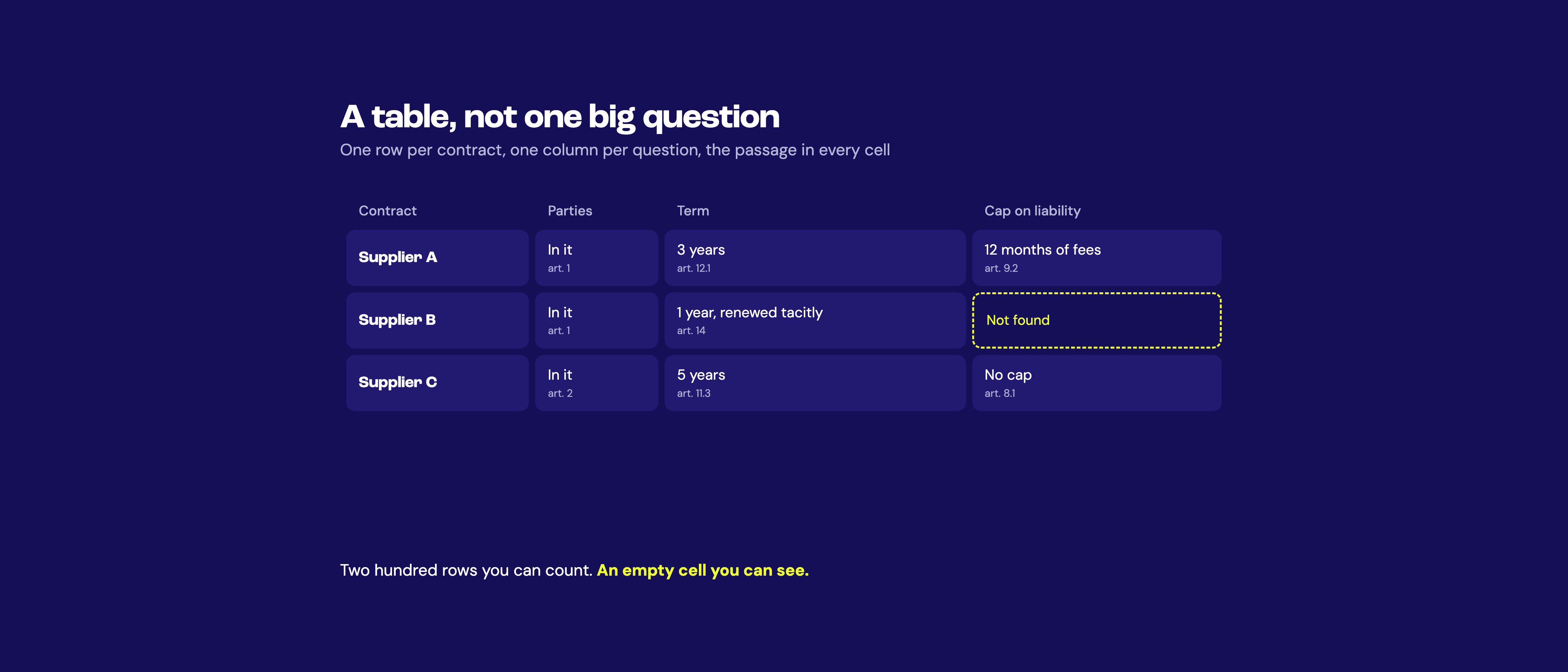
Reading, ordering, comparing, writing a first version. Going through a hundred contracts for one kind of clause. Bringing a file back to a timeline. Checking a document against the firm’s positions.
Why do you need a model here? Because the same arrangement is written differently every time. Twenty per cent up front and eighty within sixty days of acceptance. Thirty per cent on order and seventy on receipt of the bill of lading. Thirty up front and seventy against shipping documents. Always the same question: how much does the buyer pay, and when? With code you would have to think of every wording in advance. You cannot. A model can read this.
It just does not do so the same way every time, not always correctly and not always completely. Though always very convincingly. That is why the work does not disappear here: it moves.
The model’s share is also smaller than you think. A tool I built to check a contract against public sources has seven steps. The model does two of them. The rest is code, and after each step of the model, code checks its work. Someone has to say what the positions are. Someone has to read the result. With the add-in we built for a firm, a Word document comes back with tracked changes. The model writes the changes. The lawyer accepts or rejects them.
3. Steps that stay with the lawyer
Deciding what your client should do. Judging what the other side will accept. Putting your name to it.
That last one is not a detail. In July 2026 a Dutch disciplinary board reprimanded a lawyer for copying case law from an AI tool without reading it (ECLI:NL:TADRSHE:2026:93, in Dutch). The tool was not reprimanded. The Dutch bar says the same in its recommendations on AI: the lawyer stays responsible and has to understand, endorse and have checked the result.
As long as someone has to be responsible, there is a lawyer. And more stays than signing. When I wrote out for that room how you get from a table of contracts to a playbook, three of the five steps were the lawyer’s. That is no coincidence. Which questions you ask, which sources count, where judgement starts: the model does not choose that.
There is a simple way to see what stays, which I read at Every, an American publication on working with AI. A model can summarise a direction from a lot of material, and it can carry out a precise instruction. It goes wrong in the middle: knowing what the intention is, knowing what state the file is in, and turning one into the other while not everything is known. That middle is the job.
What does change
Four things, and they are not small.
You do less yourself and check more. Checking is a different skill from writing. You need to know where a model makes mistakes, and you need to set the work up so that checking is fast: the source with every answer, the quote next to it. Do not count on rest either. From in-house lawyers I hear that working faster mostly means more files at once, and that switching between them is heavier than the work itself.
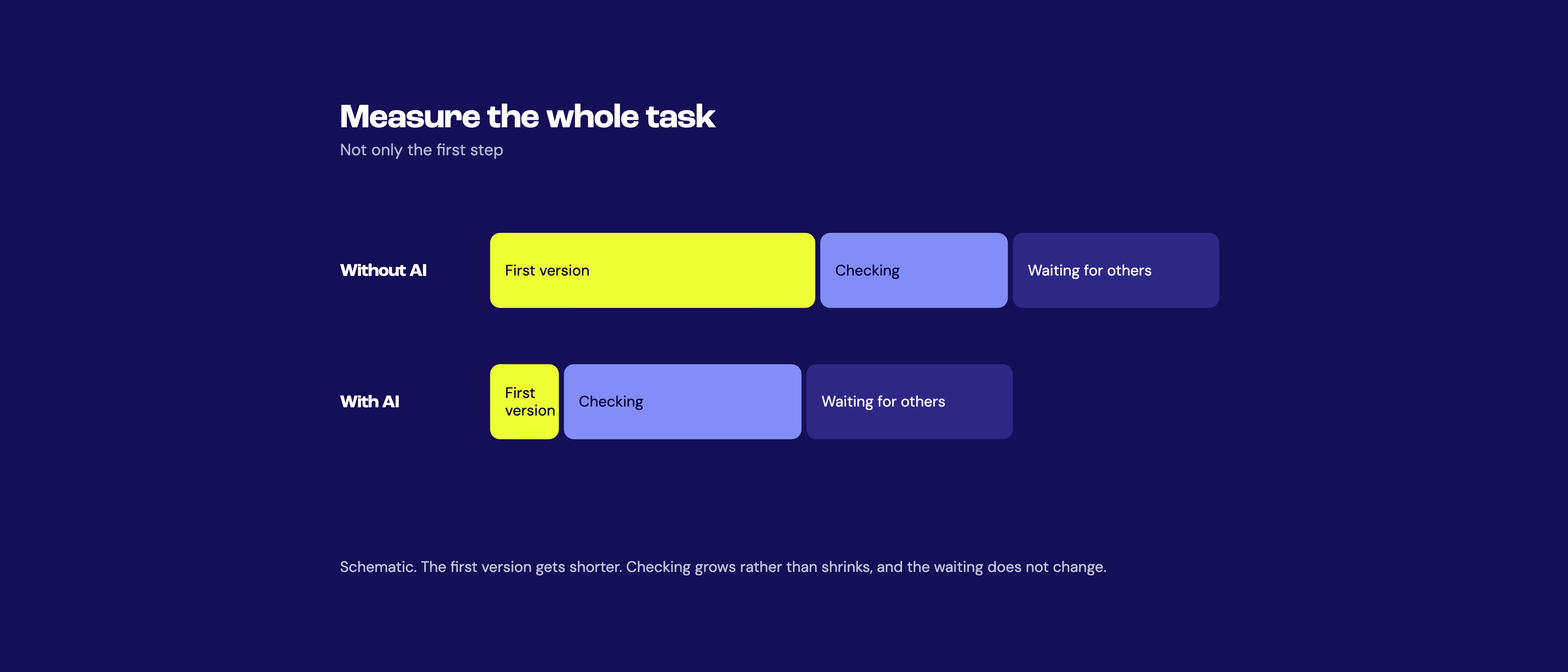
The step becomes the unit. Not only for you. I hear that in-house teams cut matters into tasks themselves and decide per task what it may cost. And if you look at your own work that way, you often see that the slow step is not the legal one. Drafting a contract is faster with AI. Waiting for the other side, the versions and the signature is not.
What you know has to be written down. A model does not know your firm’s positions. They sit in people’s heads. Whoever writes them down, in a playbook or an instruction, decides what the model does. That is legal work, and it is new work. Look in your team for the person who enjoys making a mess tidy. That profile is closer to the classic lawyer than you think.
Learning changes. The steps that go to a model are often the steps a junior lawyer learns the trade with. The Dutch bar names that risk in its recommendations and asks firms to let juniors develop the basic skills without AI as well. How to do that well, I do not know. What I hear lawyers say is that they choose: the model may make the timeline, the court document they write themselves, because they want to stay good at it. It is a question to ask now, and not in three years.
So
Will AI replace lawyers? Not the profession. It is only fair to add what Anna Guo of LegalBenchmarks calls the polite phrase she hears from legal leaders: we are not hiring more people. Nobody is fired. The team just stops growing.
Will AI replace steps in your work? Yes, and you can find out which ones today. Take the task you did three times this week. Write down the steps. Mark each one: code, AI or lawyer. You are better at it than you think. The law is a set of steps too: yes, no, exception, grey area, judgement. Lawyers already look at things like a programmer.
One caveat: I build these things, so I mostly see teams where it works. How we make that split is on the page about legal engineering.