A client sends their lawyer a letter they wrote themselves, asking what the firm thinks of it. For years the answer was that the letter was not good enough, and that the firm would write it. Now the letter is often simply good. Nick West, a partner at the English firm Mishcon de Reya, told it this way in a podcast: you used to work two hours on a letter like that, and now you spend five minutes on one change.
So what do you charge? Five minutes?
I do not advise on fees. I build ways of working with AI for legal teams, at firms and in companies. From there I do see what has to be on the table before the conversation about price makes sense. There are six things.
1. The gain is smaller than the demo
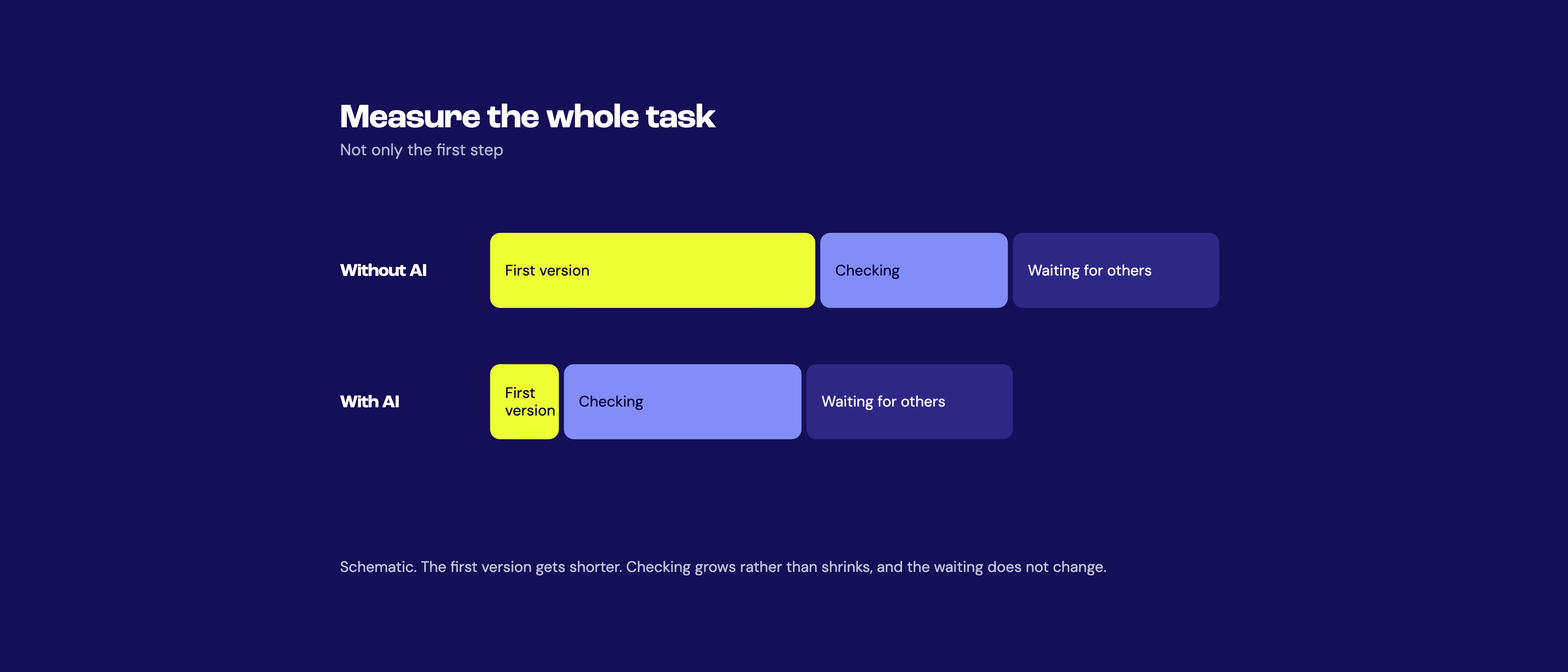
In a demo you see the first version, and that comes fast. What you do not see is what follows. From a lawyer who works this way I heard the ratio: the draft of a defence is there in three quarters of an hour, and then it takes four to five hours to refine it and check every reference. Someone else had eleven contracts compared. Without checking, an hour’s work. With checking and processing everything, a day.
So measure the whole task, not the first step. Record beforehand how long a first version, a round of review and an approval take now. Without that baseline, “it saves time” is a feeling, and you cannot agree a price on a feeling.
2. Time that is freed gets filled
The time does not disappear. It goes somewhere else.
In a legal department it goes to more contact with the business, or to work that used to be left undone. That is useful, and hard to show as a saving. At a firm, an hour gained is only revenue if other billable work is waiting. And the work expands: in a due diligence, ten contracts read become a hundred, in the same hours.
That is no argument against AI. It is the reason that “we work thirty per cent faster” rarely means the bill gets thirty per cent lower.
3. What you sell shifts
Back to the client’s letter. What happens in those five minutes is not work on the text. It is a tactical choice: do not raise this point yet, keep it for next week. And what the firm brings is experience and risk. We did a hundred of these last year; for you it is the first. And we stand behind it.
An hour is a poor measure of those two things. What comes in its place, I do not know. West says the same: he thinks nobody knows. That is a more honest start to the conversation than pretending the hourly rate will be gone next year. People have been saying that for decades.
4. AI itself costs money, and that item is moving
From lawyers I mostly hear that they see AI as overhead, like the database and the printer. The gain is mine, so the cost is too. Those who do pass it on say so beforehand in the engagement letter and put it on the invoice at cost.
Two things change that picture. Vendors are moving from a fixed amount per user to paying for usage. And an agent that works on its own uses far more than someone asking a question. The price per unit falls, the usage per task rises.
A fixed budget per person fits less and less. What I hear teams try: a budget per matter, with a signal when eighty per cent is used. Then you see per matter what AI cost, and you need that number for point 6.
5. The client does not speak with one voice
From firms I hear that clients are vague about what they want with AI. Often that is true. Inside one company, legal operations says: use AI. The responsible lawyer says: just deliver good work. Information security says: not until it has been reviewed. And procurement asks where the discount is.
With signals like that, leaving everything as it is becomes the safest choice for a firm. Nobody is to blame. Departments and firms wait for each other.
If you are a general counsel, it starts inside. One answer to three questions: may the firm use AI on our work, on what conditions, and what do we expect in return?
6. Say what is in the price
“Cheaper because you use AI” can mean two things. The same work for less money. Or less work: less checking, and less that the firm stands behind. The second can be a good arrangement, if both sides know they are making it.
The Dutch bar’s revised recommendations on AI give an example. In a due diligence you can agree with the client that AI goes through all agreements for one kind of clause, that part of the results is checked by hand, and that the rest is no longer checked if that sample is good enough. The client knows the risk and agrees. The same recommendations also say: a lawyer who charges by the hour bills the time actually spent. And fixed prices that include the cost of AI are open to everyone.
A fixed price works first for work of stable size. But then you need to know the whole chain: the checking, the corrections, the outliers. Otherwise you swap uncertain hours for a margin that leaks away. Hence point 1.
What you can do this month
As a firm. Pick one kind of work that comes back often. Measure the whole task, with and without AI, including the checking. Write one paragraph in your engagement letter on how you use AI and what that means for the cost.
As a legal department. Make sure legal, procurement and security say the same thing. Cut a matter into tasks, and ask per task what is in it: which checks, by whom, and what the firm stands behind.
One caveat: this is the view of someone who builds the ways of working, not of someone who advises on fees. What I can contribute is the measurement. How to cut a task into steps is in Will AI replace lawyers?