The word agent means almost nothing any more, because so much falls under it. One vendor calls its chatbot an agent. Another means software that works on its own for hours. For a legal team one distinction is enough.
Chat is a conversation. An agent is a repeatable process.
In a chat you ask a question and get an answer. Next time you start again. An agent does the same steps every time, with fixed sources, with checks along the way, and without you sitting there. It builds up in three steps: first chat, then a fixed way of working that you start yourself, and when that way of working runs by itself at set times, you call it an agent.
The thinnest agent is often the best
An agent does not have to be big. The thinnest form is a task that runs by itself every morning.
We built one like that for the legal department of a food retailer. Every working day it reads what the regulators published and checks it against a description of what the department wants to know. What counts comes back as a note: why it counts, what it touches, what you need to do. You also see what was dropped and why.
That is all. No assistant that sends emails, no system that decides. A process that someone used to do by hand, or that nobody did until it went wrong.
Which work suits it
Five traits. The more of them apply, the better it works.
- The process repeats. Every week, every day, with every new contract.
- The sources are fixed. You know where to look: a website, a folder, a register.
- Something has to be read. That is where the model comes in. What is only calculating or looking up, you do with code.
- The result can be checked. Someone can see whether it is right, with the source next to it.
- Nobody likes doing it. Often work a junior does now.
Examples: comparing incoming data processing agreements with your own model. Reading new legislation every week with the question whether it touches your contracts.
Sometimes the answer is: no agent. What repeats and is plain logic, such as sorting incoming requests, is often better done with a fixed form and fixed rules. An agent is only needed where something has to be read or weighed.
What makes it hard is rarely the technology. It is the information. A request to automate version control of contracts did not get stuck on the model for me, but on where the versions were: in email, in personal folders, in project folders. If everything is in one place, automating is easy. The weakest link is discipline.
An agent gets a job description
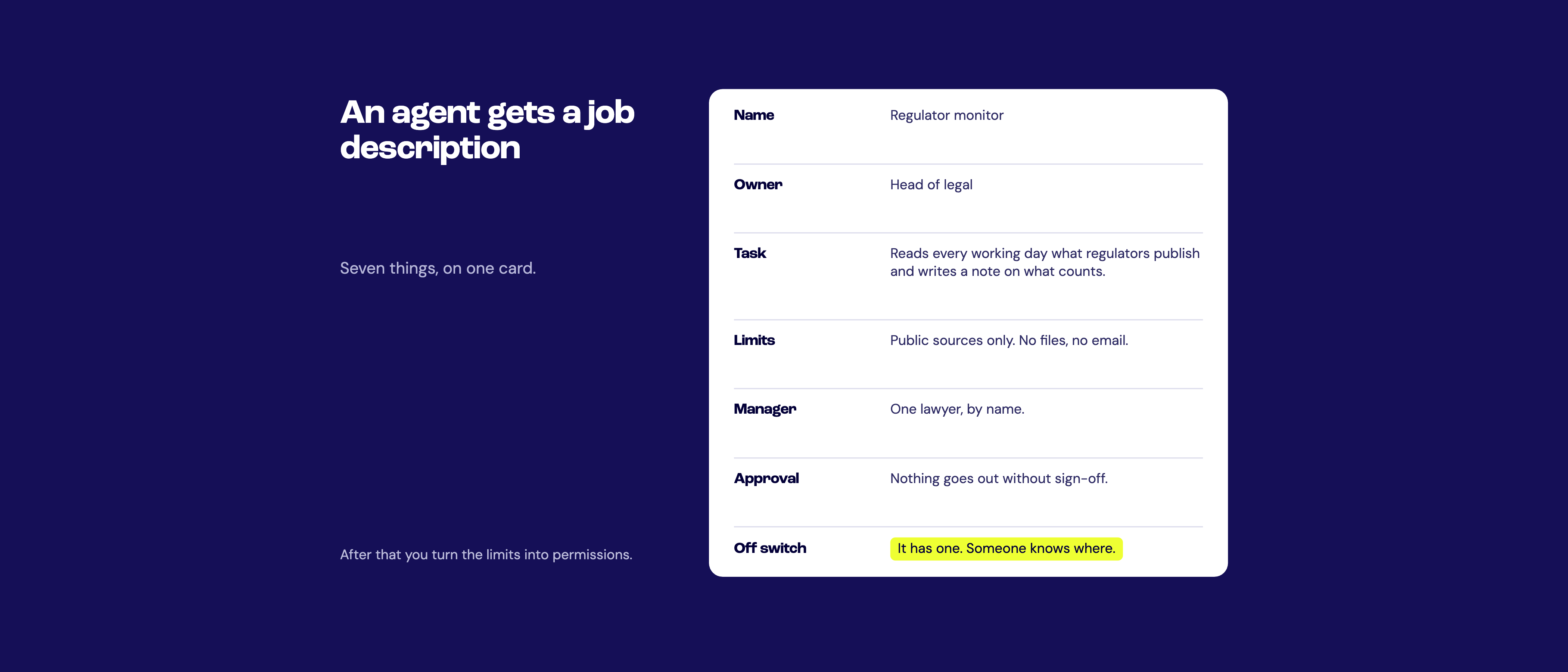
A new colleague gets a role, a manager and limits. So does an agent. Peter Lee of Simmons & Simmons calls it an agent card: one short description that stays with the agent for as long as it exists. Seven things.
- A name. So you know which one you are talking about.
- An owner. Someone who knows why the agent exists.
- A task in plain language. “This agent writes first drafts of non-disclosure agreements for internal review.”
- Limits. Which systems, data and files are in scope, and which are not.
- A manager by name. Who approves changes and is the contact when something looks odd.
- Approval moments. For an email to the outside, a payment or a publication, the agent asks for approval.
- An off switch. And someone who knows where it is.
I add an eighth myself: what does it do when things go wrong? Agents fail silently. I heard of an agent that sent documents to the wrong person without anyone noticing for a week. There is no error message. So write it down: try twice, note what went wrong, stop. And agree who reads that note.
After that you turn the limits into permissions. What the card says is “read only” must be able to read only in the system too. A rule in the instructions is a request. A permission in the system is a limit.
Also give one process only what it needs. The documents an agent would help a legal team with most are the riskiest: privileged correspondence, letters to regulators, deal documents. Start narrow and widen only when you know where it leads.
Everything as a draft
The rule I keep myself: an agent prepares, a person sends. An email becomes a draft. A change becomes a proposal. The connection to the mailbox may read and not send, so an attempt to send anyway returns an error.
Where do you draw the line? A useful question, which they use at Every: can it be undone? A draft in the file can. A letter to the other side or a court filing cannot.
And approval is only oversight if you see what you are saying yes to. The screen has to show what the agent wants to do and why. Otherwise, by the tenth time, someone clicks on autopilot. Record what was decided as well: not “the agent did X”, but that the system proposed X, and that a named person accepted or changed it. That is how you will have to explain it later.
The reason is responsibility. That the agent did it is no answer to a client or a court. The Dutch bar says so too in its revised recommendations: human oversight of every step that can have legal effect. For a bounded task, such as fetching public sources, checking afterwards is enough. For sending correspondence it is not.
The sentence that is not yours
An agent reads what others wrote: the other side’s contract, an incoming email, a web page. A model follows instructions in text. If such a document contains a hidden instruction, the agent may carry it out as if you had given it.
This is not theory. It is an easy attack, and the risk grows with what the agent is allowed to do. An agent that only reads and writes a note can do little harm. An agent that may also send email and reach your files can. One more reason for “everything as a draft”.
A practical answer is two modes. Work on a matter with web access off and only one designated folder. Research on the web without client data, with a person who carries over only the sources that are needed.
When you say no
Not everything that can be done should be. I was once asked to have assessment reports on employees written automatically from their email and Teams messages. Technically that is possible. I said no. You would let an agent do most of something big, based on messages whose writers did not know they would be read that way.
So the question with every agent is not only whether the process suits it. Also: who is the result for, and would that person be fine with it?
Start small
Pick one process that has the five traits. Do it by hand once first, so you know which steps there are. Write the card. Let the agent make drafts for a month that someone checks, and count how often that person changes something. Then you know what it is worth.
Keep counting after that. An agent that works well on day one can be quietly off its task by day thirty. Oversight is routine, as with a junior colleague: check a sample regularly, and watch whether it gets corrected more often than last month.
One caveat: most teams do not need an agent to begin with. A good way of working in the tool you already have often gets you further. How we make that distinction is on the page about legal engineering.