Since “legal engineering” is on our home page, I get one question more than before: what is a legal engineer?
It is a fair question. The title is new, and on r/legaltech some lawyers read it as a sales role with a nicer name. Mary O’Carroll, who built legal operations at Google, gives a definition I can work with on Law://WhatsNext: someone who can understand legal processes, re-engineer them, and then use technology to automate and maintain them.
My own version is shorter. A legal engineer cuts legal work into steps, and knows which step is a rule, which step a model can do, and which step is for the lawyer.
The work is older than the title
I started as a litigation lawyer. In complex cases we made timelines and diagrams to get a grip on the facts, and that became Patroon. For years we designed things and handed them over.
In 2021 Dielis joined, an engineer who thinks in code the way I think in legal structures. From then on we could build what we drew. We did not call that legal engineering. It was a lawyer and an engineer at one table, cutting a task into pieces and deciding who or what should do each piece. That is still the job.
Three kinds of steps
A rule
A step with one right answer that you can write down. A notice period. A threshold. Who is allowed to sign. This belongs in fixed code, a lookup or a decision tree. It gives the same answer every time, and you can test it.
The model
A step where language has to be read or written. Find the clause. Summarise the ruling. Draft the first version of the comment. A model does this well and fast, as long as it shows where its answer comes from.
The lawyer
A step that needs judgement. Is this risk acceptable? Is this the right moment? What does this client want? No rule and no model should take that step. The lawyer decides.
Most of what goes wrong with AI in legal teams is a step in the wrong category. A model that works out a deadline. A lawyer who retypes what a rule could have filled in. A model that is asked to decide.
One question, cut into steps
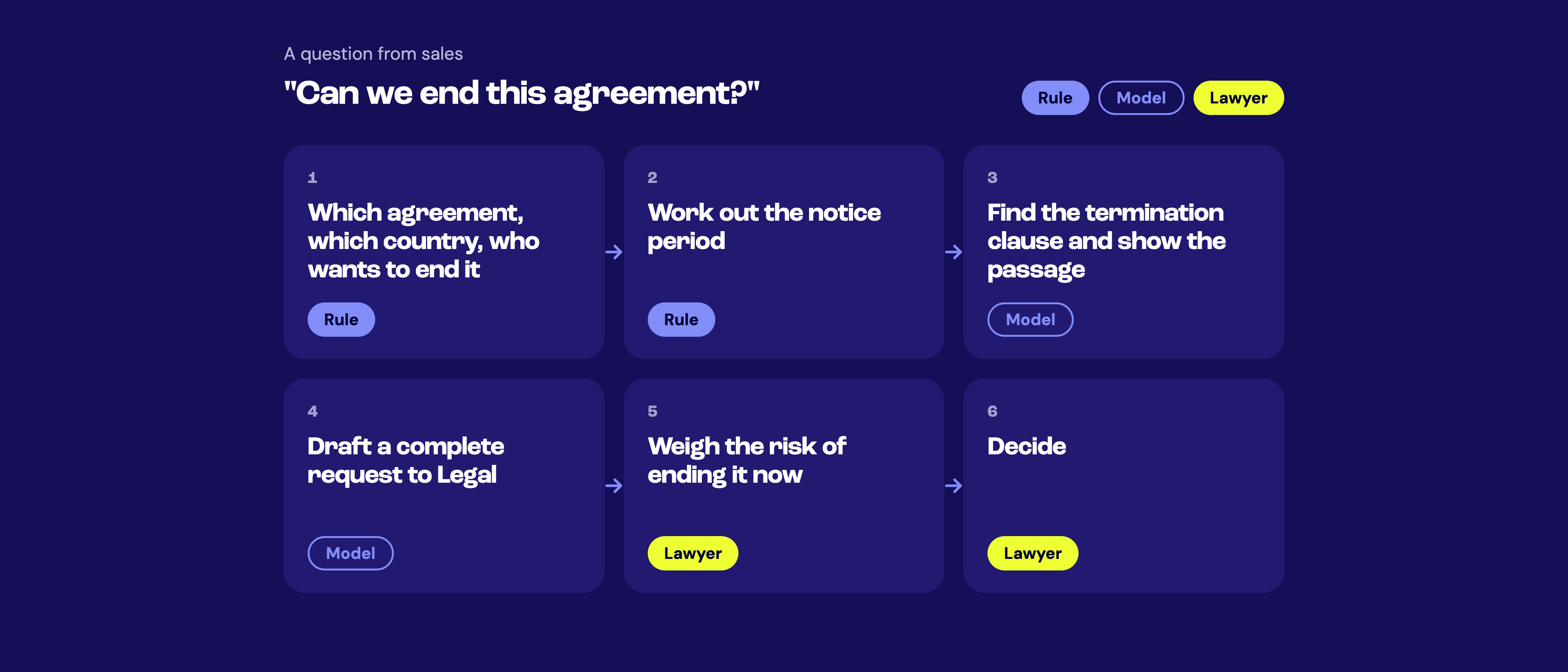
Take a question that every legal team knows. Sales wants to end an agreement with a distributor and asks Legal: can we?
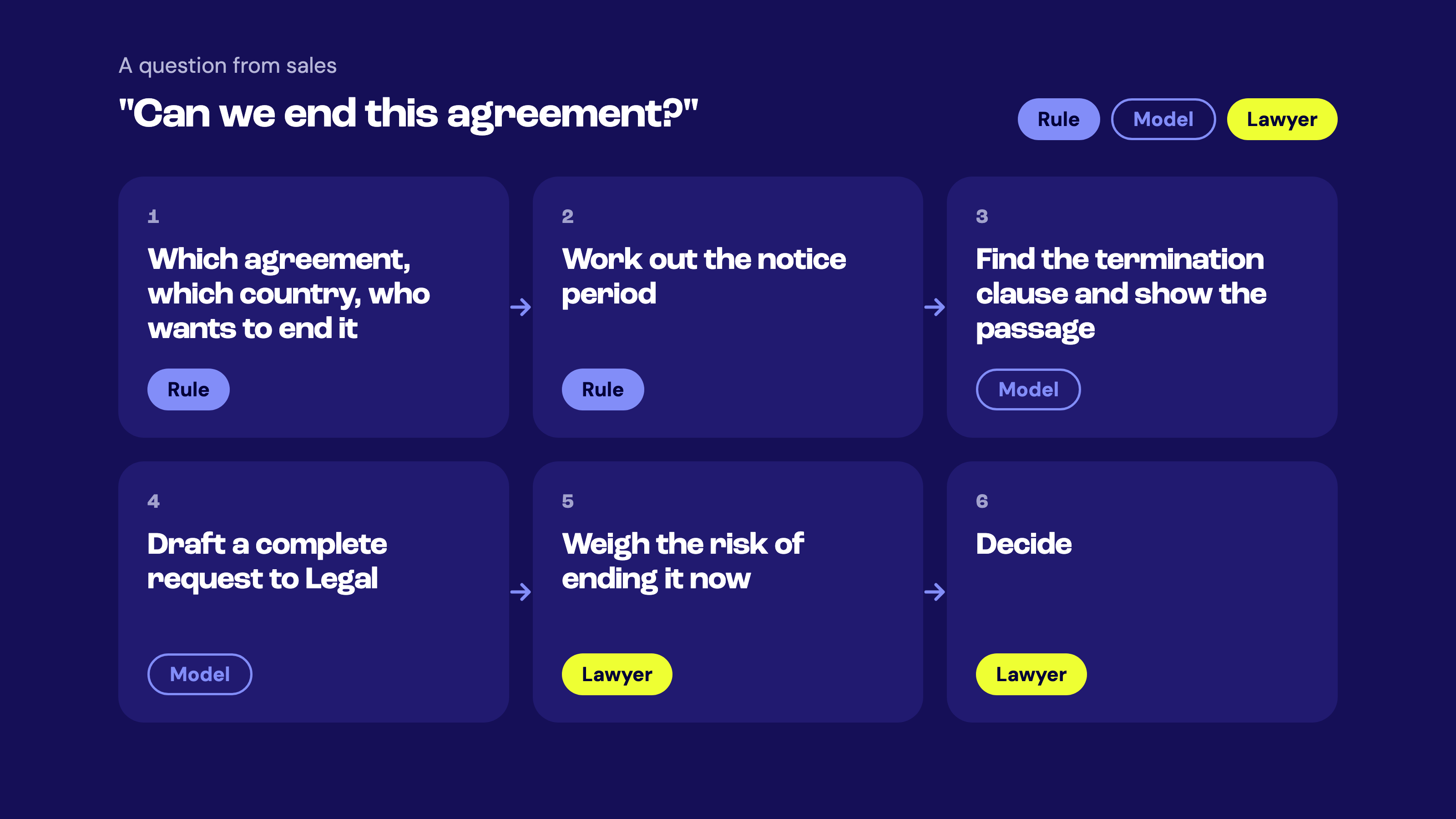
The first two steps are rules. Which agreement is it, in which country, and who wants to end it: those are fixed questions. The notice period follows from the answers.
The next two are for the model. It finds the termination clause in this contract and shows the passage. It drafts the request to Legal, complete, so nobody has to ask for the missing half.
The last two are for the lawyer. Is there a risk in ending it now? And then: decide.
We built this for the legal team of a food company. Most of it turned out to be rules. Fixed questions lead to the answer, so the same case always gets the same answer. That is often the first thing a legal engineer finds out: a large part of the task does not need a model at all.
Why it takes both
You need to know the law to see which step is a judgement. From the outside, “check the notice period” and “decide whether to give notice” look like the same kind of work. They are not.
And you need to know the technology to see what a model cannot do reliably, and what a few lines of code do better.
One person rarely has both. That is why we work as lawyers and engineers in one team.
You do not need the title
The next time a task comes back, ask of every step: is this a rule, is this for the model, or is this for the lawyer? If you want to start there, this is how I would do it. And when the model’s part has to be checked, build it so that a lawyer can.