In three rulings on AI in court documents the same word comes back: search engine. An American lawyer took ChatGPT for a “super search engine”. A Dutch lawyer told the disciplinary board she saw AI tools as a kind of search engine. It did not help her. And one Dutch court itself writes about “ChatGPT or a similar search engine”.
That is the misunderstanding. A search engine fetches something that exists. A language model writes the text most likely to follow. Ask for case law and you get something that looks like case law: a court, a date, a case number in the right format. The model does not say what it does not know.
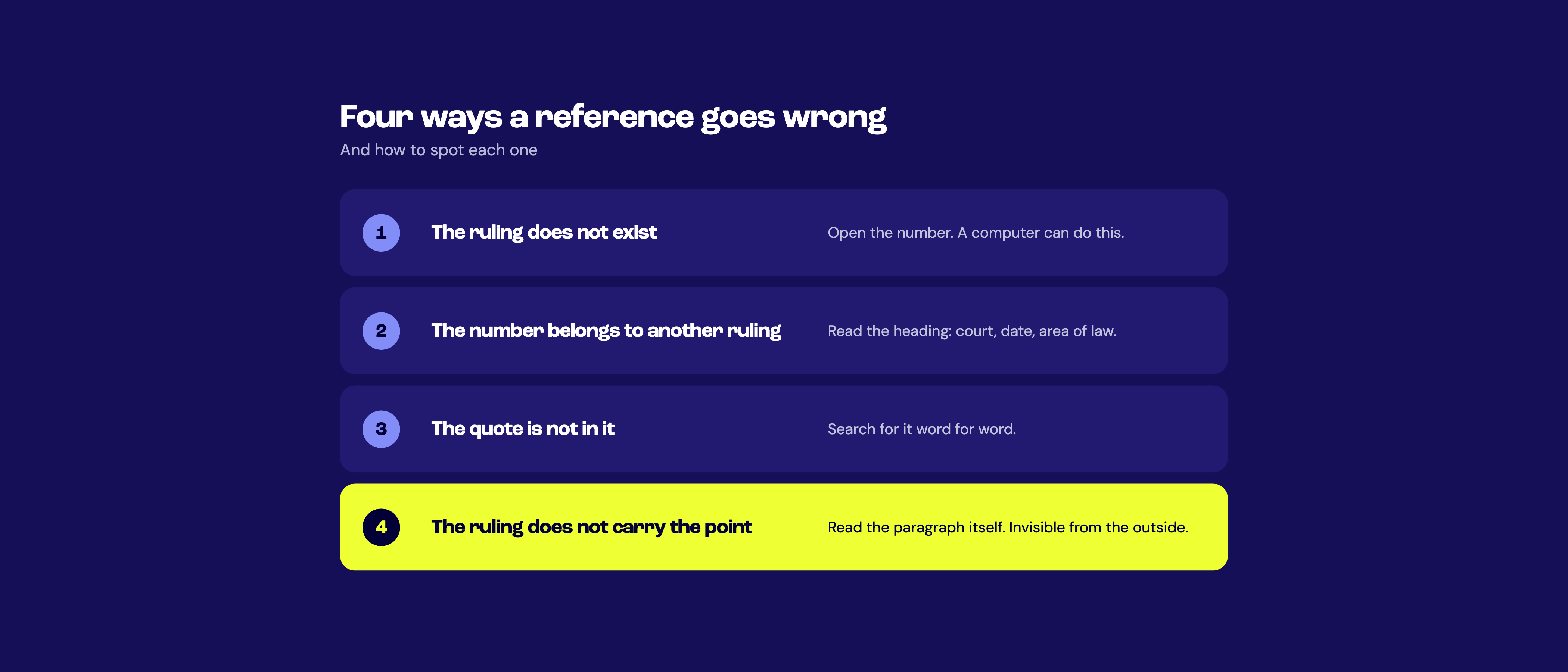
For my trainings I collected seventeen rulings in which this came up, twelve of them Dutch, each opened at the court itself. It is a set, not a complete overview. What stands out: it does not go wrong in one way, but in four. And the fourth is the most dangerous.
1. The ruling does not exist
The best-known case. In a tenancy case in Eindhoven a lawyer cited eight rulings. One case number (ECLI) did not exist (ECLI:NL:RBOBR:2026:909, in Dutch).
How to spot it: open the number at the official source. It takes ten seconds per reference, and it is the only one of the four that a computer can do for you.
2. The number exists, but belongs to another ruling
In the same tenancy case the seven other numbers did exist. They belonged to entirely different rulings, among them a divorce order and a criminal case. At the Council of State an appeal about a housing plan referred to numbers that were about immigration law (ECLI:NL:RVS:2026:4143).
This is more treacherous than the first. If you only check that the link works, you see a real ruling and move on.
How to spot it: read the heading. Court, date and area of law must match what your document says about it.
3. The ruling exists, the quote does not
In an asylum case the grounds of appeal contained a quote between quotation marks, in italics, attributed to an existing ruling. The quote was not in it. The court searched further and did not find it in any other ruling either (ECLI:NL:RBDHA:2025:22590).
To a model, quotation marks are formatting. They do not mean the sentence is written anywhere.
How to spot it: search for the quote word for word in the text of the ruling. If it is not there, it is not a quote.
4. The ruling exists, but does not carry the point
In an inheritance case a lawyer relied on two judgments of the Dutch Supreme Court. The court looked them up. One was a tenancy case, the other a case from Aruba about a time limit. Neither contained the rule they were cited for (ECLI:NL:RBNNE:2025:4814).
Another court saw a subtler version. The cited rulings all existed, but some were about something other than what they were cited for (ECLI:NL:RBGEL:2026:1608).
This is the kind I worry about most. An American court of appeals calls it more dangerous in the long run than invented cases, because you cannot see it from the outside. The link works, the court is right, the subject looks close. Only the ruling does not say what you say it says.
There are finer versions. The passage is an obiter remark. It is the argument of the party that lost. The ruling has since been overtaken. Each time the reference is right, and only what it is used for has shifted a little.
And as tools get better, the problem moves here. A tool that really searches case law invents a number far less often. It can still pick the wrong passage, or summarise a paragraph in the direction of your question. And the inventing comes back at one moment, I hear from lawyers who work with these tools: when nothing fits your question exactly. Then a model fills the gap.
How to spot it: read the paragraph itself, not the summary. There is no shorter way.
And what is not there
The four checks above test what is cited. They say nothing about what is missing. An answer can lean on one strong ruling and miss the line of cases that goes against it. Cited cases you can check. Missed case law you only find by searching again yourself.
So use the result as a starting point, not as an overview.
What a tool needs
A smarter model does not solve this. What helps is giving the model something to stand on. When you assess a tool for case law, ask four things.
What does it search in? A general chatbot without a source answers from memory, and a model is not a database. A tool that first searches a collection of rulings and then answers only from that starts somewhere else.
Does it show the passage? Not just the number, but the exact paragraph the answer rests on, one click away from the ruling itself. A claim with a source you can open yourself: that is the point.
What does it check itself? Whether a number exists and whether a quote is literally in the text does not need a model’s judgement. Code can do that. In one of the tools we built, code checks after each step of the model whether the passages it refers to exist. If a source returns something unexpected, it stops. Better no answer than an answer that looks plausible.
May it say there is nothing? Some questions should not get an answer. A tool that returns something for every question fills in where nothing was found. Ask too whether the model reads the whole ruling, or a summary someone else made.
Whether the ruling carries the argument stays yours.
What courts do about it
In the eleven Dutch court rulings in my set, not one lawyer or representative is sanctioned by the court. The consequence is always the same: the argument does not count. For the client that is bad enough. The one measure against a lawyer came from the disciplinary board, a reprimand in July 2026, after the judge had informed the dean of the local bar.
What makes the difference is what happens after the mistake. A representative in an asylum case found out himself, while preparing for the hearing, that the references in his appeal were wrong. When the court asked, he said he had made the appeal with ChatGPT, and he asked the court to disregard that part. The court regretted the way of working: the other side and the court had already had to go through the references. But it left the part out of consideration and imposed no sanction (ECLI:NL:RBDHA:2026:9527). The lawyer in the tenancy case withdrew her references without putting anything in their place. The disciplinary board found that not enough.
In none of these rulings is the use of AI the reproach. The reproach is filing without reading.
Five questions per reference
Does the number exist? Does it belong to this ruling? Is the quote in it? Does the paragraph say what I say? And does it still hold?
The first three take a minute together. The fourth takes as long as reading the paragraph. The fifth has always been part of it: the Dutch bar names it explicitly in its recommendations on AI, checking that a ruling has not been overtaken by later case law. That is not lost time that AI should have saved you. That is the work.
One caveat: seventeen rulings are a set. I have not searched the Dutch case law databases exhaustively, and there will be more. How to organise this checking in a team is in the article on AI literacy for lawyers.